
Markdown copy of 2026-11-09 NSF news AI Infrastructure Hubs (web).html, made 2026-11-09. The original is the authority. Skip to main content
[image on the original web page: /themes/custom/nsf_theme/plugins/uswds/dist/img/us_flag_small.png]
An official website of the United States government
Here’s how you know
Here’s how you know
[image on the original web page: /themes/custom/nsf_theme/plugins/uswds/dist/img/icon-dot-gov.svg]
Official websites use .gov
A .gov website belongs to an official government organization in the United States.
[image on the original web page: /themes/custom/nsf_theme/plugins/uswds/dist/img/icon-https.svg]
Secure .gov websites use HTTPS.
A lock (LockLocked padlock) or https:// means you’ve safely connected to the .gov website. Share sensitive information only on official, secure websites.
[image on the original web page: NSF - U.S. National Science Foundation - Home] [image on the original web page: /themes/custom/nsf_theme/components/molecules/logo/logo-wordmark.svg]
Search Menu
[image on the original web page: Close navigation]
Search
search
- Find Funding
-
- Funding Search
- Award Search
- NSF-wide Initiatives
- Research Experiences for Undergraduates
- Where to Start
- For Everyone
- For Early-Career Researchers
- For Postdoctoral Fellows
- For Graduate Students
- For Undergraduates
- For Industry
- For Entrepreneurs
-
- How to Apply
-
- Preparing Your Proposal
- Submitting Your Proposal
- Proposal & Award Policies & Procedures Guide (PAPPG)
- Additional Resources
- Research.gov
- Grants.gov
- How We Make Funding Decisions
-
- Manage Your Award
-
- Getting Started
- Request a Change to Your Award
- Report Your Outcomes
- Proposal & Award Policies & Procedures Guide (PAPPG)
- Additional Resources
- Research.gov
- NSF Public Access Repository
- Who to Contact With Questions
-
- Focus Areas
- Major Initiatives
- Super Intelligence
- Biotechnology
- Quantum
- STEM Workforce
- Focus Areas
- Explore All Focus Areas
- Arctic and Antarctic
- Astronomy and Space
- Biology
- Chemistry
- Computing
- Earth and Environment
- Education and Training
- Engineering
- Facilities and Infrastructure
- Materials Research
- Mathematics
- People and Society
- Physics
- Research Partnerships
- Technology
- Major Initiatives
- News & Events
-
- News & Announcements
- NSF Impacts
- Science Matters Blog
- For the Press
-
- Upcoming Events
-
- About
- About NSF
- Careers at NSF
- Updates on NSF Priorities
- Contact Us
- Our Directorates & Offices
- How NSF Is Organized
- Biological Sciences (BIO)
- Computer & Information Science & Engineering (CISE)
- Engineering (ENG)
- Geosciences (GEO)
- Integrative Activities (OIA)
- International Science & Engineering (OISE)
- Mathematical & Physical Sciences (MPS)
- Social, Behavioral & Economic Sciences (SBE)
- STEM Education (EDU)
- Technology, Innovation & Partnerships (TIP)
- National Center for Science & Engineering Statistics (NCSES)
- National Science Board (NSB)
- About NSF
- Home
- News
- New NSF State and Regional AI Infrastructure Hubs will power AI-enabled scientific research across the country
Print this Page
NSF News
New NSF State and Regional AI Infrastructure Hubs will power AI-enabled scientific research across the country
August 4, 2026
New initiative will accelerate AI-enabled scientific discovery by expanding access to compute for researchers, students and educators through regional partnerships among state and local governments, academic institutions, industry and philanthropy, and will build a highly skilled technical workforce to leverage AI and computing for science
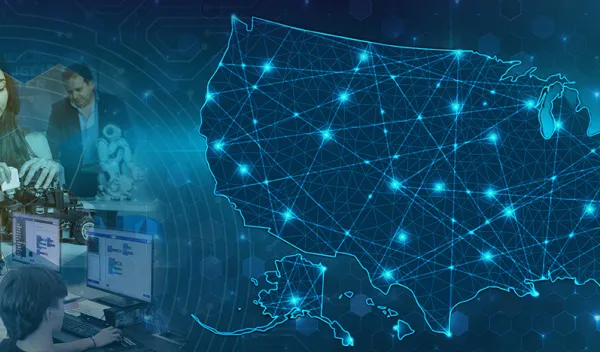
The U.S. National Science Foundation announced the NSF State and Regional Artificial Intelligence Infrastructure Hubs program, a $100 million initiative to drive AI-enabled scientific discovery and innovation across disciplines. The program will transform research and workforce development by expanding access to compute, data and other AI resources that frontier science now requires.
The program responds to core recommendations in Science: A New Golden Age, a report published by White House Office of Science and Technology Policy Director Michael Kratsios in July 2026, which lays a policy foundation for renewing America’s research and development enterprise. The report calls for laying the foundation of a new era of AI-enabled scientific discovery and supporting American scientists to do their best work, including through expanding world-class R&D infrastructure. The administration’s Fiscal Year 2028 R&D priorities memorandum, issued in parallel with the report, calls for investing in AI for science as a national mission and expanding the scale of, and flexible access to, advanced compute and data infrastructure now required for frontier scientific discovery.
As advances in AI continue to transform scientific discovery, maintaining U.S. leadership in fundamental and translational research requires that researchers and students across the country have access to cutting-edge AI infrastructure. Today, access to AI infrastructure remains highly uneven across the nation.
To address this challenge, the program will help establish AI Infrastructure Hubs, flexible state and multistate regional consortia that leverage contributions from research institutions, philanthropic organizations, state and local governments, and the private sector to build and operate cutting-edge scientific compute for researchers, students and educators in the region. NSF will play a catalytic role, investing in each hub’s consortium coordination, AI infrastructure workforce development and AI for science faculty training and curriculum development to put compute resources to work for scientific discovery.
“Artificial intelligence is transforming how we conduct research, accelerate scientific discovery and address complex challenges across disciplines,” said Brian Stone, performing the duties of the NSF director. “The State and Regional AI Infrastructure Hubs program supports a national mission to advance AI for science by expanding access to critical AI resources, strengthening state and regional ecosystems, and developing the workforce capabilities needed to harness these technologies. Through this effort, we can empower researchers, students and communities to advance AI-enabled science and drive the next generation of scientific breakthroughs.”
“American scientists deserve the world’s best tools to enable their most ambitious work,” said Michael Kratsios, assistant to the president and director of the White House Office of Science and Technology Policy. “In Science: A New Golden Age, we called for expanding access to world-class R&D infrastructure, including advanced compute, to reflect how science is conducted today. These hubs deliver on that commitment in the most practical way possible. Regional partners who share in the benefits of discovery will pool their resources to unlock compute at a scale that no individual stakeholder, and no federal program, could achieve alone.”
NSF will initially support up to 10 AI Infrastructure Hubs, with one award made per state or region. In addition to pooling resources across states and institutions large and small, each hub will also partner with regional industry to align AI for science workforce development with local job market needs.
Specifically, NSF will invest in AI infrastructure professionals with the technical expertise to support researchers, students and educators in applying AI infrastructure for scientific discovery; connect meritorious research with AI Infrastructure hubs in their regions; and invest in faculty and educator training and instructional material development to build students’ skills, proficiency and knowledge in using computing, data and software systems for scientific research.
AI Infrastructure Hubs are encouraged to integrate with national resources such as the NSF-led National AI Research Resource, providing the ability to surge and share resources beyond local capacity and enable dataset sharing. The program supports the White House-led Genesis Mission, a national effort to harness AI for science. Hubs are encouraged to engage with relevant NSF AI initiatives such as TechAccess: AI-Ready America and existing national structures such as the Campus Research Computing Consortium for workforce development.
Many private-sector and philanthropic organizations, including NVIDIA, AMD, Intel, Dell Technologies, Hangar and the Secunda Innovation Fund, among others, intend to support participants in the State and Regional AI Infrastructure Hubs program. NSF welcomes the engagement from additional organizations to help advance the goals of the program.
Research areas
Directorate for Computer and Information Science and Engineering (CISE)
Directorate for Technology, Innovation and Partnerships (TIP)
Directorate for STEM Education (EDU)
Topics
- Super Intelligence
- Computing
- Education
Share
Share on FacebookShare on X (formerly known as Twitter)Share on LinkedInEmail
Related stories
New dwarf planet candidate discovered by NSF–DOE Rubin Observatory
Podcast: The hidden DNA code that controls your genes
NSF–UKRI metascience statement
Top
-
Publication date:
August 4, 2026
-
Last updated:
August 17, 2026
[image on the original web page: NSF - U.S. National Science Foundation - Home] [image on the original web page: /themes/custom/nsf_theme/components/molecules/logo/logo-wordmark--white.svg]
Randolph Building 401 Dulany Street Alexandria, VA 22314
(703) 292-5111
- [image on the original web page: Facebook]
- [image on the original web page: X (formerly known as Twitter)]
- [image on the original web page: Instagram]
- [image on the original web page: YouTube]
- [image on the original web page: LinkedIn]
- [image on the original web page: RSS]
Footer
-
About Us
- About NSF
- Careers
- Our Directorates & Offices
- National Science Board
- Contact Us
-
What’s New
- News & Announcements
- Events
- Science Matters Blog
-
Information For
- Funding Seekers
- NSF Awardees
- Congress
- Media
- Educators
- Panelists
-
Resources
- Documents & Reports
- Budget, Performance & Financial Reporting
- Public Access
- Stopping Harassment
- Research Security
- Scientific Integrity
- Research.gov
Required Policy Links
- Vulnerability disclosure
- Inspector General
- Privacy
- FOIA
- No FEAR Act
- USA.gov
- Accessibility
- Plain language